Scored Space is a series of photographic explorations examining how bodies create space that I have been developing with Kim Wilczak, a graduate of the Landscape Architecture program at Cornell University. The project uses two cameras and synchroballistic photography to record movement. The images are then compiled and arranged to create stereoscopic images, recording motion as a spatial gesture. Our goal was to generate images that capture the movement, both formally and spatially, in a continuous fashion. The intent behind the creation of these images is to document how liminal space is created by physical iterations without relying upon geometry. This paper describes our process and progress to date.
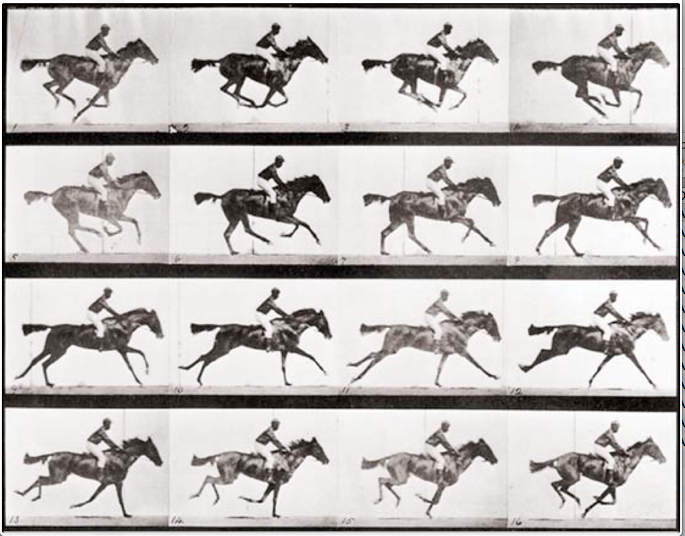
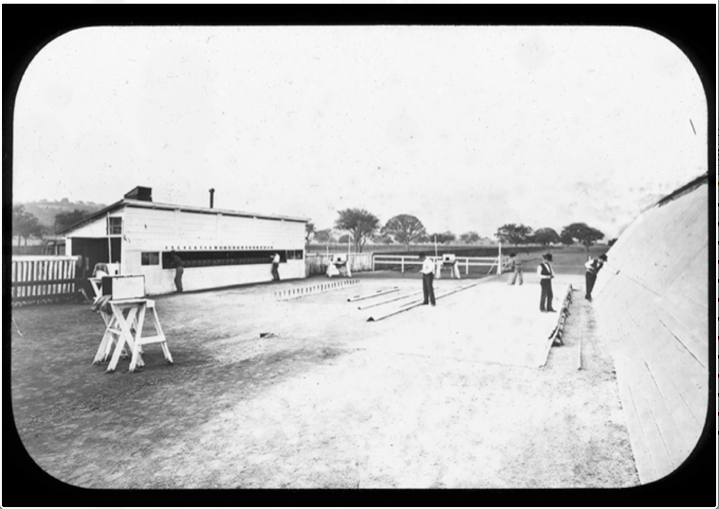
The project is inspired by two significant film-based projects that record motion of persons. The first of these is the work by Eadweard Muybridge, recording the procedural movements of persons. Muybridge’s work stemmed from a series of images that he had taken to document the motions of the horse “Occident” in an effort to determine how it’s gait worked relative to the ground. The horse’s movements were captured as a series of still images from a series of cameras that were positioned parallel to the track. Panels were arranged on the other side of the track path to create as much visual contrast between the horse and the background as possible. The resulting images were then compiled into a machine device made by Muybridge that relied upon the persistence of image perceived by the human eye to create an early form of cellular animation.
More importantly, the movie proved to serve as the foundation for a series of examination of how the body moves procedurally. After documenting the movements of Occidental, Muybridge worked in a studio space photographing then movements of people. Working this environment he was able to optimize lighting, and placed measured lines on the background, enabling movements to be measures relative to a space. It is also interesting to note that these studio constructions was the ability set up multiple cameras to record the movements of people spatially. Given the arrangement of the studio, the images are set up on Cartesian axes, but do create a set of referential images that allow the viewer to imagine the space occupied by the body in a manner that is very similar to the architectural sectional elevation drawing.
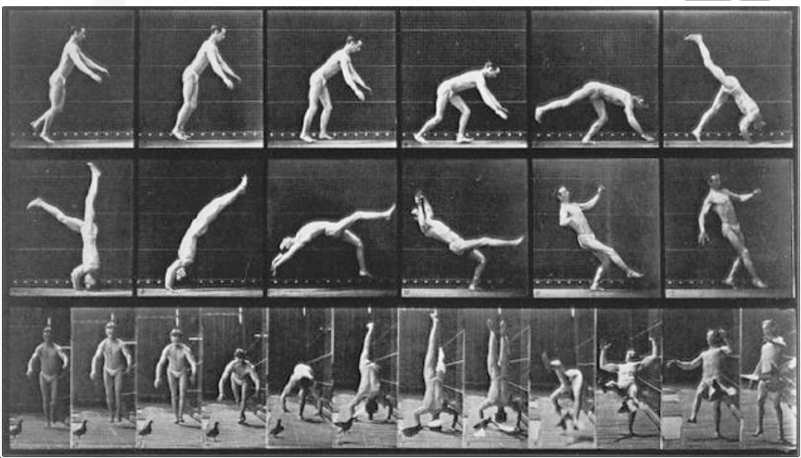
The Muybridge photographs provide us with three points of consideration. The first is movement has been of long standing interest, not solely as a gestural set of movements, but as a something capable of being measured based on the size and shape the body and through repetition. This differs slightly from form the prescriptive nature of chorography, in which the movement of the body is described prior to the actual movement. The second point is that despite the limitations of technology, three-dimensional space was of interest. Therefore, it can be postulated that Muybridge’s photographs as much about making space as they about motion. However, the studio environment limited the ability of Muybridge to record the motions of individuals in casual environments. The images were also limited in how the record the physical relations of multiple bodies moving through share environments.

This is in contrast to the second precedent, in which used the “outdoors” as the lab space. William Holly Whyte is celebrated for his work recording how people used space in urban environments. Central to his work was an interest in how people interacted in in public spaces. Almost a century after the work of Muybridge, Whyte engaged in a disciplined observation of streets and plazas in New York City called the “Street Life Project.” The primary goal of the project was to identify why people use certain spaces more than others, and became widely recognized in his book “The Social Life of Small Urban Spaces.” While the findings describe in the book and the associated film with the same name has become invaluable to the practice of making public spaces in urban environments, the methods of recording movement in the spaces are more valuable to our project.
Whyte employed the use of time-lapse photography to record how people occupied numerous spaces within the city. Here we have an application of film in a similar fashion that of Muybridge, although in a more intentional fashion. Muybridge was limited by his technology. Placing strings in strategic locations completed the process of triggering the camera lens. Once “tripped,” the photograph would be taken. This severe limitation of technology was overcome over time through mechanical systems that would repeatedly trigger the camera base on a program increment. Thus time lapse became a significant part of recording the body in urban environments.
This simple calibration created a manifested a significant change in how the body was recorded in urban environments. Rather than trying to describe the body in a series physical or spatial manipulation, time becomes the driving factor. Therefore, in addition to addressing questions of “relative to what,” the matter of “at what time” is brought to the forefront. The work has the effect of confirming some information that was already observed anecdotally, but also had brought to light numerous subtle patterns of use in the spaces that were examined.
Despite this rigor applied to the work there are still some limitations to Whyte’s work. The first of these is embedded in the camera technology and scale of the spaces being examined. Whyte was working at the scale of the block and the urban plaza, thus loosing some of the immediacy with the body present in the observations of Muybridge. More importantly, given the use of cameras from a relatively close point of view, the spatial relationships that are present in between persons on the street become two dimensional. Compared to the Muybridge’s use of two cameras within his studio to record motion simultaneously, there is a loss of content in the work. Therefore, while the broad brushstrokes revealed in the time-lapse photography is invaluable, it is also problematic in that the details are lost as part of the process of recording the space from medium to long range distances. The time-lapse photographs also lack some of the subtleties of movement through space, given the increment of time between frames.
Given these two precedents, one that attempted to spatialize movements of the body and one that record adjacencies in space over a period of time, we still faced with the problem of resolution. In both cases the period of time between each image was not capable of displaying movement with any great reliability. This led us to use synchroballistic, or slitscan photography as a means to record motion. When speaking in terms of analog formats, this method of photography involves exposing a continuous strip of film along a thin lens aperture. The resulting image is distorted, revealing time through the blur of the slit scan and the presence of movement across the lens aperture.

Common applications include finish line photography for track and bicycle races. More technical applications include evaluating the rotation of high-speed projectiles. In these cases the body in motion is the primary thing of concern. This usually requires that the camera be positioned perpendicular to the plane of movement. In our case, we are interested exclusively in how the object moves, as much as we are interested in the spatial relationships that are revealed when while the images are generated.
We use a digital platform, utilizing the open source-programming environment Processing and a program sketch based on one created by Golan Levin. We capture an aperture that is one pixel wide, and control the image width and frame rate to describe periods of time. Using a digital platform, we are able to tune the images to the motion being captured. We also intentionally positioned the camera at oblique angles to the area of study. This generated some three-dimensional qualities based on how spaces overlap or stack in the image, especially when multiple modes of movement are evident. More significantly, and the size of objects and their form become exaggerated relative to their speed and the frame rate. Objects moving across the lens at a faster rate became proportionally smaller compared to those that moved at a slower rate. In this image of people playing kickball in park adjacent to a street you can see how size become distorted as part of the image. If you were to apply rules of perspective to determine the height of the people, they would be taller than the vehicles in the foreground.

While depth of space is suggested in the images, a “real” sense of three-dimensional space is absent from the images using a single camera. At this stage, we switched from using a single camera to record space to two cameras aimed at the same location. The first set of test images were constructed using two smartphones with slitscan camera apps, allowing us to quickly adjust the focus of the camera towards the same point in three dimensional space. The paired images are later combined on a page for viewing. Three-dimensional space “appears” when the viewer crosses their eyes at the correct distance from the image (which in itself present multiple problems).
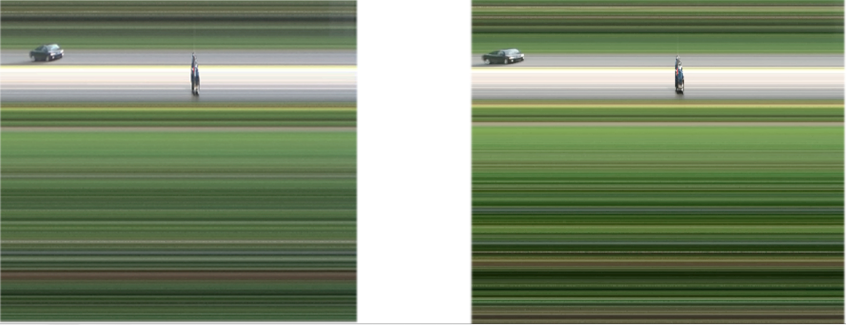
Aside from the issues related with people who cannot cross their eyes and the ensuing headaches for those people who can cross their eyes, we determined that a major boundary facing us for this version of the project was dues to the limited view of landscape based on the blurred background. These lines across the images are a representation of points that are not in motion. The successive lack of motion at these points in the single pixel wide images that are stack horizontally results in the streak. This we found to be too abstract, limiting how spatial conditions within the landscape also determine the movement of individuals.
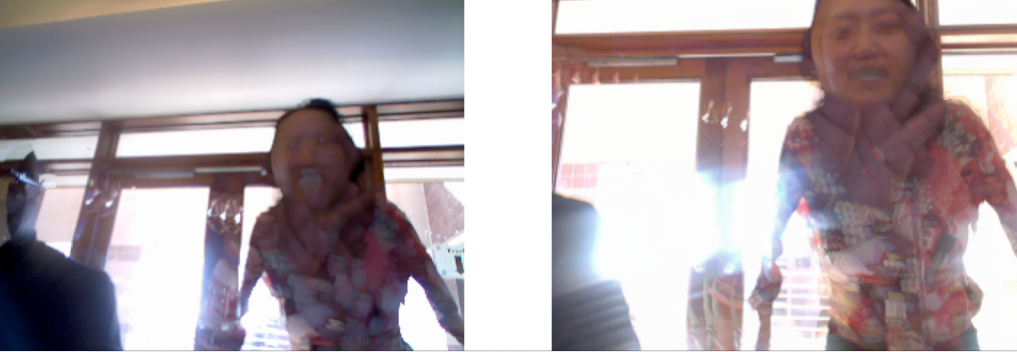
In the latest iteration we are using another sketch written for the processing programming environment. This one is based on a script originally written by Heino Boekhout, which was written to capture photographic images in a conventional manner, but then layers them into a single layer at a defined frame rate. Movement in this case registers as a staccato blurs across the environment being recorded. We have modified the sketch to record movement from two cameras simultaneously, allowing us to create stereoscopic images without the need for assembling the images separately. The significant advantage to this method of recording movement in space is that the space becomes an active part of the image, allowing us to identify how people interact with static objects.
Despite the promise we can see in constructing images using this method, we are presently running into technical issues. We are using camera from two different web cameras, and as you can see in the differences between the two images, the difference in how the lenses are constructed has a significant effect on how the two images do (or do not match up). The construction of the ccd’s also plays a significant role in how light is recorded in the image. Finally, there is a very significant factor that the two cameras must be focused and centered on the same point in the images to create stereographic images that are capable of being easily viewed. Therefore we will need to construct a harness that will hold two cameras accurately approximating the distance between the pupils in the eye (6.5cm), while being capable of being focus independently on a single point. Finally, while we have not tested our cameras for this, we will need to address issued of frame rate paired with images size in order to get the “best” images possible, without overclocking the web cameras, pushing the ccd’s to failure.
Therefore we find ourselves at an interesting point in the project that is shared by all the preceding work. We are investigating movement through space in order to observe how the body moves, in a “contemporary” manner using software as the instrument for production and subsequent image production. In relying upon software, we find ourselves pushing against the limitation of the technology, which becomes an active part of making the images, or recording the content. In this way we find ourselves in a similar position to that of Muybridge and Whyte, determining ways in which we can best use the technology to accomplish the goals of the observations.
 Making Agency